
Environmental Management & Resource Circulation
Governance
Strategy
Risk Management
Metrics and Targets
Decision-Making and Implementation Framework
Board Level
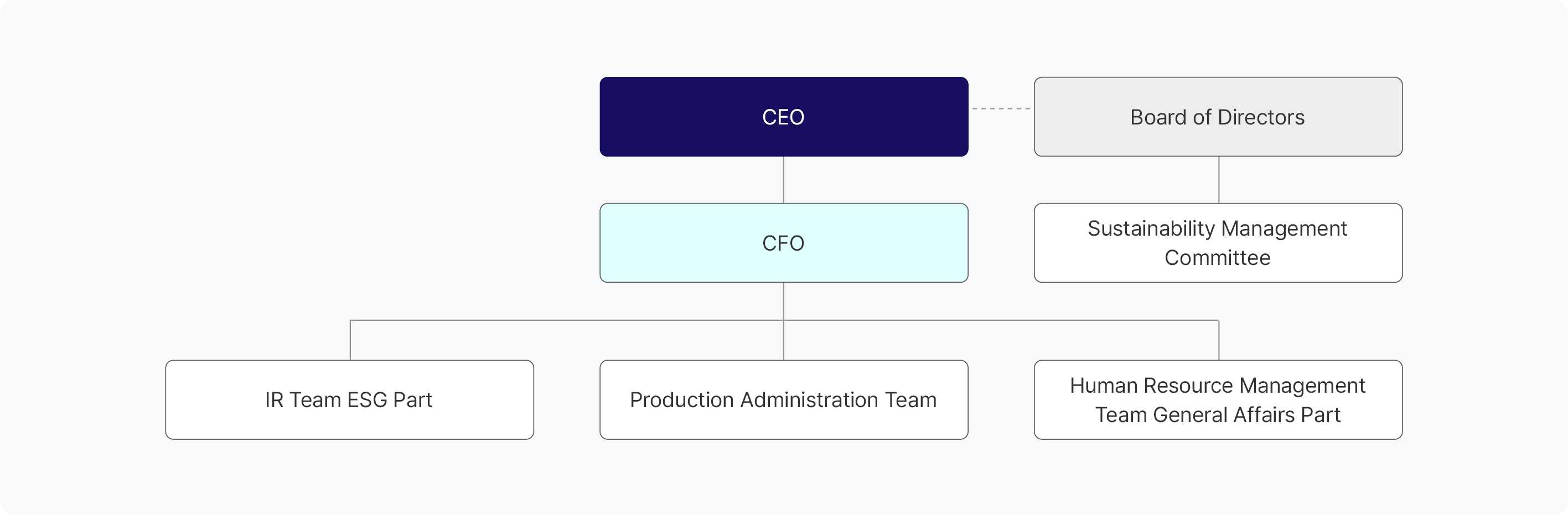
The Sustainability Management Committee, under the Board of Directors of Studio Dragon, identifies risks and opportunities related to environmental management and resource circulation, overseeing the development and implementation of corresponding response strategies. During 2025, the committee convened three times to deliberate on and approve key agenda items, including GHG (greenhouse gas) inventory development, ISO 14001 Environmental Management System (EMS) certification strategy, GHG emissions management strategy, and participation in environmental initiatives and campaigns.
Sustainability Management Committee Organization Chart
2025 Sustainability Management Committee: Environmental Resolutions and Reports
*As of December 31, 2025
1. | Report | Agenda Item for Reporting: 2025 Sustainability Management Performance |
|
|---|---|---|---|
2. | Resolution | Agenda Item for Approval: 2026 Sustainability Management Priority Strategies |
|
3. | Report | Agenda Item for Reporting: Integrated Risk Management Framework |
|
Management Level
Studio Dragon pursues systematic environmental management by clearly defining roles and responsibilities across the organization and implementing environmental management activities based on cross-functional collaboration. In particular, environment-related indicators, including improving external ESG rating, have been incorporated into the Key Performance Indicators (KPIs) of the Chief Financial Officer (CFO). This initiative accounts for 10% of the CFO's total KPI weighting and is directly linked to financial compensation based on performance evaluation results, thereby strengthening management-level execution of environmental management practices.
The Finance Department’s IR Team ESG Part serves as Studio Dragon’s dedicated environmental management organization and oversees all environmental management operations, including operating the EMS (Environmental Management System), ensuring environmental regulatory compliance, and managing energy consumption. The team also leads the development of medium- and long-term environmental management strategies and drives participation in major environmental initiatives and campaign operations. The Human Resource Management Team, General Affairs Part has established and operates the Green Procurement Policy, incorporating environmental considerations into the selection of business partners. In facility and site management, the team continues to advance waste reduction activities in collaboration with the headquarters building operations center. The Production Administration Team coordinates closely with content production sites and systematically manages waste generated on sets, implementing reduction projects to enhance waste recycling rates through partnerships with specialized waste management vendors. Through this role-based division of responsibilities and cross-functional collaboration, Studio Dragon systematically advances environmental management, including waste management and resource circulation, while strengthening the foundation for sustainable business operations.
Environmental Management Risks and Opportunities
Waste-Related Risks and Opportunities
Studio Dragon is advancing systematic waste management and reduction at content production sites through various resource circulation initiatives. Producing content requires diverse materials—including production sets, props, and costumes—which can generate waste such as wood and plastic. Without proper management, this waste can pose environmental risks and can undermine resource circulation systems. Studio Dragon has introduced reuse and recycling processes in the development of production sets, props, and costumes to improve resource efficiency and minimize waste generation. Since 2023, the company has built reuse systems—including asset management of production materials and operation of prop and equipment warehouses—to enhance resource circulation and improve resource efficiency in production.
Studio Dragon is also actively integrating innovative technologies such as AI and Virtual Production (VP) at content production sites to reduce physical set construction and expand the use of reusable and recyclable materials. These efforts simultaneously create opportunities to reduce production costs and minimize environmental impact. Going forward, Studio Dragon will continue to minimize waste management risks and build a sustainable production ecosystem grounded in resource circulation through the development of environmentally responsible production practices.
Biodiversity-Related Risks and Opportunities
Content production involves diverse activities, including location filming, physical set construction, and the transportation of production equipment. These activities may disturb or damage surrounding wildlife habitats. Without appropriate management, they can negatively affect local ecosystems and contribute to biodiversity loss—a key environmental risk in the content production process.
Studio Dragon manages these risks by complying with environmental regulations and content production site management standards, and by implementing ongoing management activities to reduce environmental impacts during production. The company is also strengthening biodiversity conservation and restoration efforts to enhance its environmental accountability and create a sustainable content production environment that meets stakeholder expectations. Going forward, Studio Dragon is committed to building an environmentally responsible content production environment in which content production activities and natural ecosystems coexist harmoniously, and to contributing to biodiversity conservation.
Environmental Management Strategy
Environmental Management Pillar
Studio Dragon systematically implements environmental management by setting strategic directions, including ‘building an eco-friendly content production environment’, ‘expanding resource circulation-based production processes’, ‘strengthening greenhouse gas and energy management’, and ‘advancing environmental management system’, with the aim of realizing a sustainable content industry through the creation of an environmentally sustainable production environment.
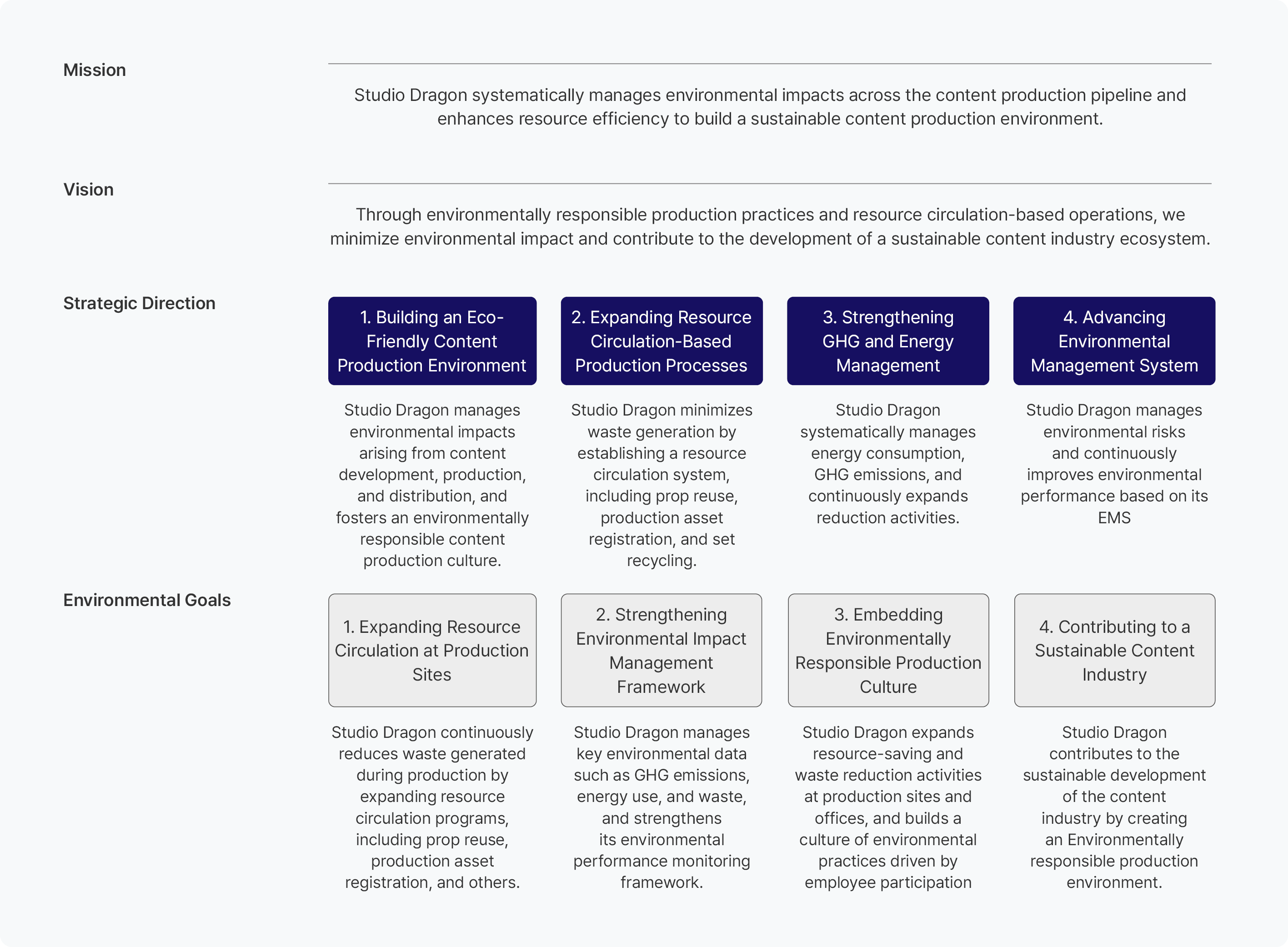
Environmental Policy
Environmental Management Commitment
Studio Dragon is advancing environmental management across the entire content life cycle—from development and production through distribution—to systematically manage environmental impacts. The company embeds environmental management into its overall business operations, addressing key environmental issues including climate change, resource efficiency, and waste management. Building on its EMS, Studio Dragon continuously monitors and improves its environmental performance while fostering a sustainable content production environment.
Environmental Policy
Studio Dragon has established the Environmental Policy, placing climate change, resource circulation, and sustainable content production at the core of its environmental management approach and integrating these principles across all business operations. The company reduces its environmental impacts by improving energy efficiency, minimizing resource consumption, and expanding waste reduction and recycling programs, thereby contributing to building a sustainable content industry ecosystem.
Environmental Management Framework
Studio Dragon has established the Environmental Management Framework and applies it across the organization to ensure systematic environmental management. The framework sets targets that account for environmental risks and opportunities and operates on the principle of continuous management and improvement of environmental performance. The company shares environmental responsibility with its employees and business partners and is committed to practicing sustainable management.
Green Procurement Policy Operations
Studio Dragon has established the Green Procurement Policy to minimize environmental impacts that may arise from content production and business operations, promoting sustainable procurement by prioritizing eco-certified products and those with lower environmental impact. The company uses Forest Stewardship Council (FSC) certified eco-friendly paper cups and, beginning in 2025, transitioned all printing paper to FSC-certified stock. The company also encourages double-sided printing and implements other paper reduction measures, contributing to reduced paper waste and resource circulation.
In 2025, Studio Dragon purchased KRW 9.2 million worth of eco-certified products, representing 68% of total procurement. Going forward, the company will continue to expand the range of eco-friendly products in its procurement activities and maintain environmentally conscious purchasing practices, thereby advancing environmental protection and sustainable management.
Waste Prevention Initiatives
Space for Reusing Props: Promoting the Prop Warehouse
Studio Dragon established a props warehouse of approximately 115.7㎡ at its headquarters in August 2023 to advance props reuse during production. The company subsequently expanded operations to the CJ ENM Studio Center and built an integrated props database, creating a system for sharing props across scripted series to reduce unnecessary new props production and continues to promote resource circulation. Approximately 130 props used across roughly 30 scripted series are currently registered in the database and stored in the warehouse. Going forward, Studio Dragon will continue to minimize new props production by sharing and reusing available inventory across projects, reduce waste generated during content production, and create a sustainable content production environment based on resource circulation.
Category | Unit | 2025 | ||
|---|---|---|---|---|
Number of Scripted Titles Using Prop Warehouse | Titles | 10 | ||
Number of Props Reused | Items | 50 | ||
Space for Reusing Production Materials: Promoting the Production Material Warehouse
Studio Dragon established an asset management process for production materials beginning in the second half of 2025 to prevent duplicate purchases during content production and enhance resource efficiency. As of February 2026, the company has registered more than 130 types of materials and manages them systematically in an internal warehouse. After project completion, materials used in writers' offices, production offices, directing offices, and production sites are recovered and registered to enable reuse. Through this initiative, Studio Dragon minimizes unnecessary purchases, increases resource efficiency, and contributes to reducing production costs and mitigating waste. Additionally, since the second half of 2025, six newly launched projects have reused asset-managed materials. Going forward, the company plans to continuously expand the material asset management and reuse system to create a sustainable content production environment based on resource circulation.
Category | Unit | 2025 |
|---|---|---|
Number of Scripted Titles Using Production Material Warehouse | Titles | 6 |
Number of Materials Reused | Items | 21 |
Production Materials Warehouse
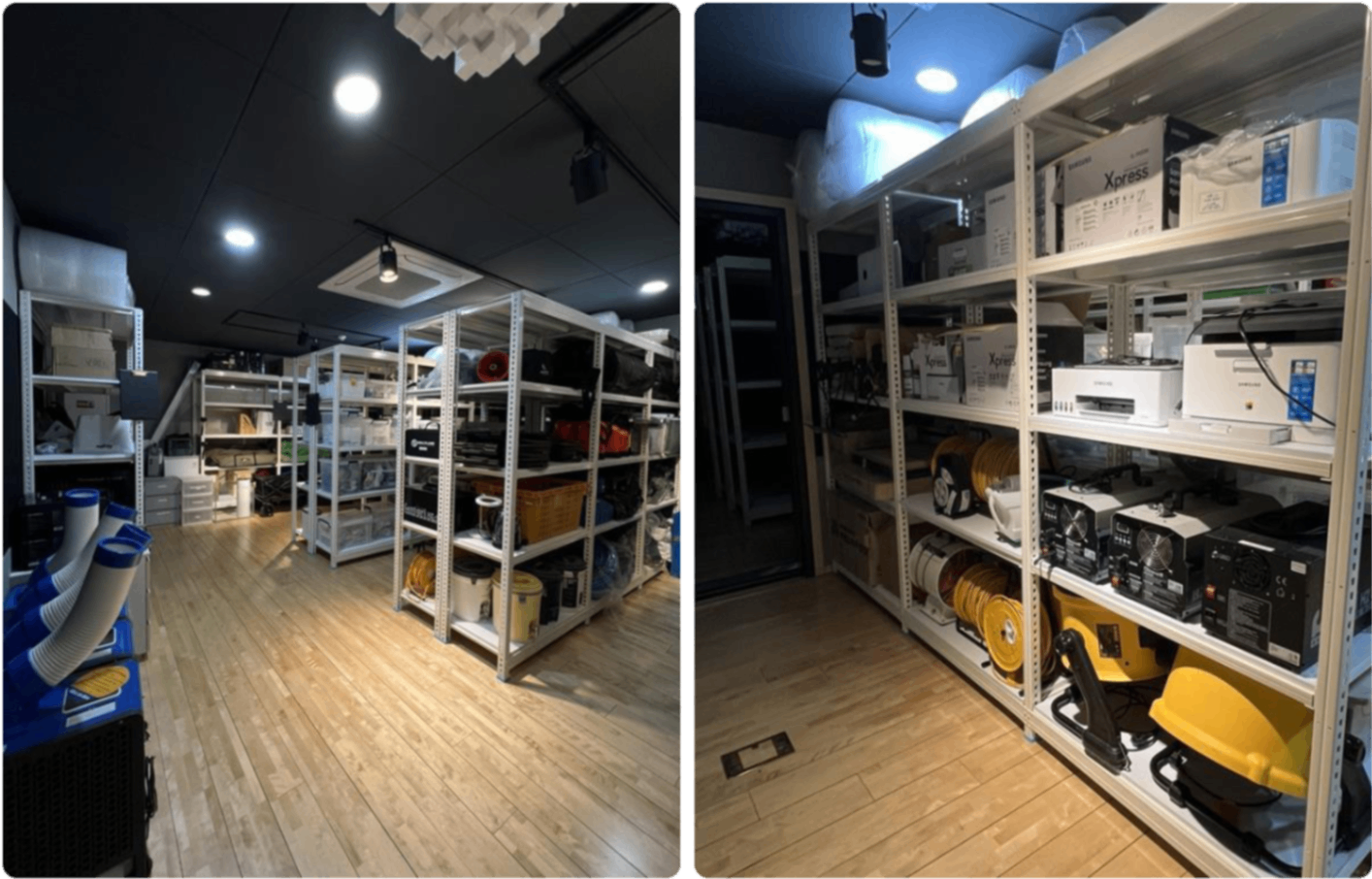
Photo Credit: Studio Dragon
Office Waste Reduction Initiatives
Studio Dragon is implementing various initiatives to systematically manage and reduce waste generated at its offices. As of 2025, the volume of waste generated at Studio Dragon's headquarters was approximately 11.7 tons, a relatively low level compared to manufacturing industries. Nevertheless, the company continues to pursue ongoing improvements in reducing resource consumption and minimizing waste. To raise employee environmental awareness and encourage sustainable practices in daily operations, the company implements on-site waste segregation at its headquarters. The company also conducts environmentally responsible campaigns that employees can implement in their routine work, including promoting the use of reusable cups and reducing paper consumption. Going forward, Studio Dragon will expand waste reduction activities based on employee participation and minimize environmental impact through various resource circulation initiatives that enhance resource efficiency.

Compliance with Waste Management Principles
Studio Dragon strictly complies with all regulations governing waste management in occupied buildings in accordance with Article 13 of the Wastes Control Act. For scripted series production sites, waste generated after production concludes is classified and processed by specialized waste management vendors for each project, including recycling1) and reuse2). Reusable props and materials are verified and stored by the Production Administration Team.
1) Converting resources to alternative uses or processing them for reuse
2) Using resources in their original form without reprocessing
Wastes Control Act, Article 13 |
|---|
① Anyone who intends to treat wastes shall comply with the standards and methods prescribed by Presidential Decree: with respect to wastes that are made readily recyclable in view of the principles of recycling wastes and matters to be observed under Article 13-2 (hereinafter referred to as ‘intermediately processed wastes’), relaxed standards and methods may separately be prescribed by Presidential Decree. |
Waste Recycling Process Enhancement
Studio Dragon has entered into a memorandum of understanding (MOU) with Hansol HomeDeco to establish a process for regenerating waste wood generated during set construction and demolition, and plans to advance implementation. Wood materials account for approximately 80% of total set construction material consumption; however, most wood was typically disposed of after single use due to safety concerns such as reduced load-bearing capacity. Through this collaboration, Studio Dragon plans to regenerate a substantial portion of waste wood from set demolition into MDF1) and interior boards. Based on typical waste wood generation of 50–70 tons per production, the company expects to recycle up to 2,000 tons of waste wood annually.
1) MDF (Medium Density Fiberboard): engineered wood created by breaking down wood into fine fiber form, mixing with adhesive, and compressing and molding into shape
Partnership for Recycling Construction Set Wood Waste
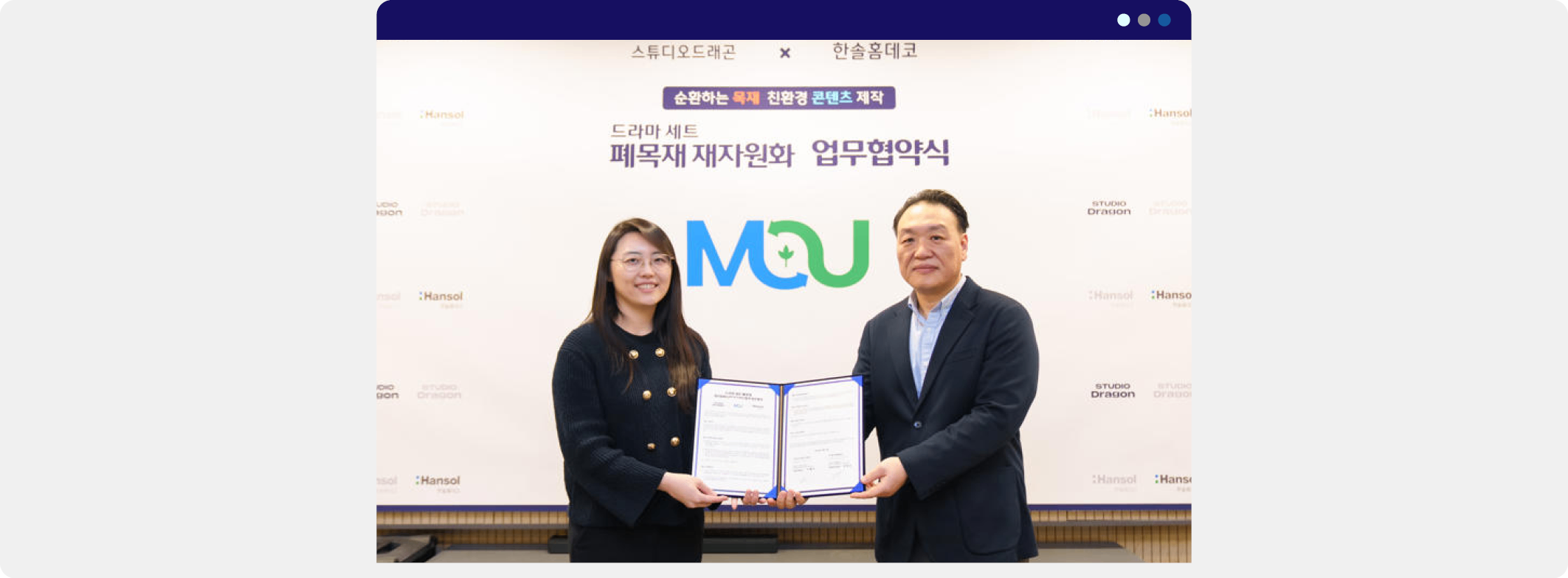
Photo Credit: Studio Dragon
Minimizing Physical Set Production and Establishing Low-Carbon Processes
Studio Dragon is advancing its management system through a technology-centered approach to minimize environmental impacts across content production. In 2025, moving beyond simple technology, the company focused on realizing a high-efficiency production model that reduces resource consumption through infrastructure sharing among affiliates.
Low-Carbon Content Production System Based on Virtual Production (VP) | Studio Dragon has secured competitive capabilities in producing vehicle scenes through a strategic barter collaboration with CJ ENM’s VP Stage. By leveraging ICVFX1) technology to render driving scenes on in-studio LED walls, the company has eliminated the need for actual road control or tow-vehicle (picture car) operations. This approach has significantly reduced large-scale equipment movement and fuel consumption that would otherwise accompany on-location filming, translating into a tangible reduction in single-use waste generated at production sites. In particular, this mutual growth achieved through technical consultation has become a new resource circulation model, optimizing content production resources while enhancing cost efficiency.
1) ICVFX (In-Camera Visual Effects): technology that implements visual effects (VFX) in real time during the production phase
Content Production Resource Optimization Through AI Technology | Studio Dragon has expanded its use of AI-based visual production technology to minimize physical set construction. Beyond pre-production stages, the company now applies AI technology directly during main production—including music videos, promotional content, and background source creation for its productions—enabling high-quality visual implementation without building physical sets or undertaking large-scale location moves. This approach prevents wasting production resources, reduces unnecessary retakes and set reconstructions, and serves as a key driver in continuously lowering on-set waste generation.

Photo Credit: Studio Dragon
Ecosystem Conservation and Restoration Initiatives
Propagating Endangered Plants and Creating Conservation Habitats
In April 2025, Studio Dragon partnered with Key-chungsan Botanical Garden to advance biodiversity conservation through the propagation of endangered plant species and the creation of an ex situ conservation site. The initiative focused on four endangered wildlife species designated by the Ministry of Environment: Pogostemon yatabeanus, Epilobium hirsutum, Saururus chinensis, and Cicuta virosa. Studio Dragon supported artificial propagation and planting to establish habitats, which were subsequently monitored for effectiveness.
Through support for artificial propagation at Key-chungsan Botanical Garden and the creation of ex-situ conservation sites—including soil preparation and planting tailored to optimal growth conditions—the company directly contributed to increasing populations of protected species. The ex-situ conservation area expanded from 660 square meters to 1,000 square meters, and the population of nationally protected species increased by 500 individuals. Additionally, Studio Dragon operated a biodiversity education program for 104 individuals from underserved communities visiting the botanical garden, helping raise awareness of ecosystem protection.
Studio Dragon Endangered Plant Habitat Creation within Key-chungsan Botanical Garden

Photo credit: Studio Dragon
Endangered Plant Species with Increased Population Through Studio Dragon Support
Cicuta virosa | Pogostemon yatabeanus | Epilobium hirsutum | Saururus chinensis |
|---|---|---|---|
 |  |  |  |
Photo credit: This material was created by the National Institute of Ecology in 2016 and released under Creative Commons Attribution 1.0 (Creator: National Institute of Ecology), and the material can be accessed on the National Institute of Ecology website.
Fostering an Environmental Management Culture
Employee Environmental Training
Studio Dragon conducts regular environmental training for employees to foster environmental management awareness. Through these sessions, the company shares its environmental management strategy and framework, key management areas, and priority issues. In 2025, Studio Dragon provided EMS implementation briefings and training to strengthen environmental management capabilities for eight representatives from departments involved in the ISO 14001 certification audit.
Environmental Training Metrics
Category | Date | Participants | Content |
|---|---|---|---|
Capacity-Building Training | Feb. 12, 2025 | 8 representatives from audit | Briefing on ISO 14001 framework implementation and training to strengthen environmental management capabilities |
Capacity-Building Training | Jun. 10 to 14, 2025 | ESG Part | Training on GHG Verification |
Environmental Management Campaigns and Global Initiative Participation
Studio Dragon has operated ‘ESGD (Everyone Saves Green Dragon)’, an environmental campaign based on voluntary employee participation, since 2022. The campaign is designed to reduce energy consumption and foster environmental awareness through daily employee actions. It comprises a range of environmentally responsible activities implementable within the office environment, including proper waste separation and disposal, use of reusable cups, water conservation, minimization of paper use, and enabling PC power-saving mode. In addition, Studio Dragon actively participates in global energy conservation initiatives by conducting lights-off events at the company and at home in observance of ‘Earth Hour’ and ‘Earth Day’.
Studio Dragon participates in the UN Global Compact (UNGC), a global sustainability management initiative, and adheres to its ten principles, including environmental responsibility. As a responsible corporate citizen, the company is committed to creating sustainable value. Going forward, Studio Dragon will continue to fulfill its environmental responsibilities through participation in global initiatives and contribute to the advancement of environmentally sustainable value.
Earth Hour & Earth Day Poster
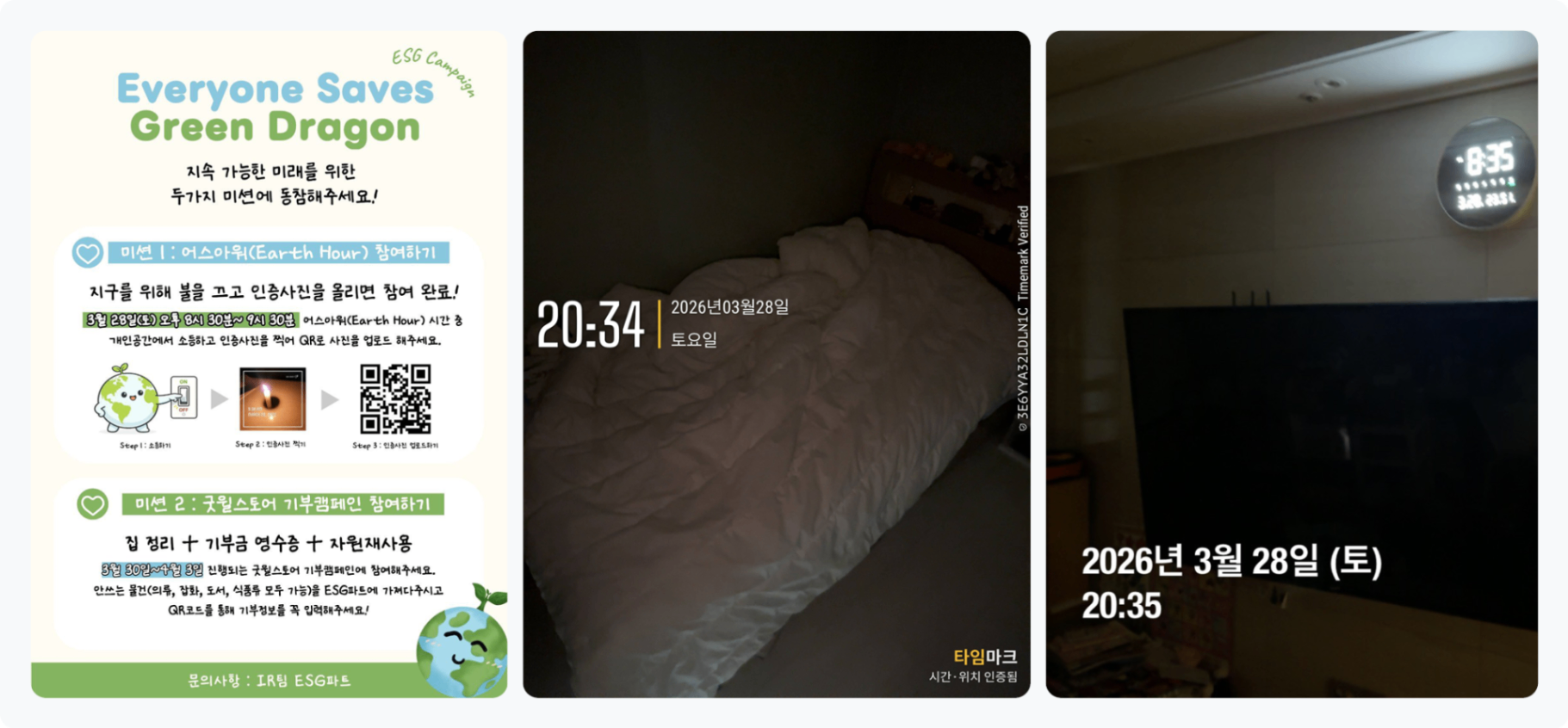

Photo Credit: Studio Dragon
ECP (Eco-Balanced Content Production) Initiative Participation
ECP is an ESG initiative designed to foster a sustainable content industry by protecting natural ecosystems during production and service delivery, and by supporting balanced development of the industry ecosystem. Studio Dragon joined the ECP Initiative, an ESG collaborative body established by the Korea Creative Content Agency, CJ ENM, the Korea Drama Production Association, and the Korea Independent Production Association, in December 2022. The company participates as one of 23 member organizations. ECP establishes standards across six key areas—including Energy Efficiency, Carbon Footprint, and Recycle & Upcycle—to protect natural ecosystems during production. Studio Dragon is committed to adhering to these standards throughout its production processes.
ECP, Natural Environment Ecosystem Standard
Category | Standard |
|---|---|
Energy Efficiency |
|
Carbon Footprint |
|
Recycle & Upcycle |
|
Water Security |
|
Forest Protection |
|
Animal Welfare |
|
Environmental Risk Management
Environmental Management System (ISO 14001) Certification
Since obtaining its initial ISO 14001 certification in 2023, Studio Dragon has continuously operated an Environmental Management System (EMS) based on ISO 14001 requirements, conducting systematic management activities to ensure compliance with domestic and international environmental regulations and minimize potential environmental risks. The company’s risk identification, mitigation, and monitoring procedures are grounded in the PDCA (Plan-Do-Check-Act) cycle, enabling it to continuously enhance the effectiveness of its environmental management.
In 2025, Studio Dragon had system's conformity validated through a regular surveillance audit and strengthened internal capacity by conducting ISO 14001-based environmental management training for relevant departments and employees. Going forward, Studio Dragon plans to systematically maintain and advance its EMS in accordance with the PDCA cycle.
Environmental Risk Management PDCA Process
Category | Process | Environmental Impact Assessment | Issue Identification and Risk Assessment |
|---|---|---|---|
PLAN | Planning and Target Management |
|
|
DO | Operational Management |
|
|
CHECK | Monitoring and |
|
|
ACT | Corrective Action and Improvement |
|
|
ISO 14001 Certificate
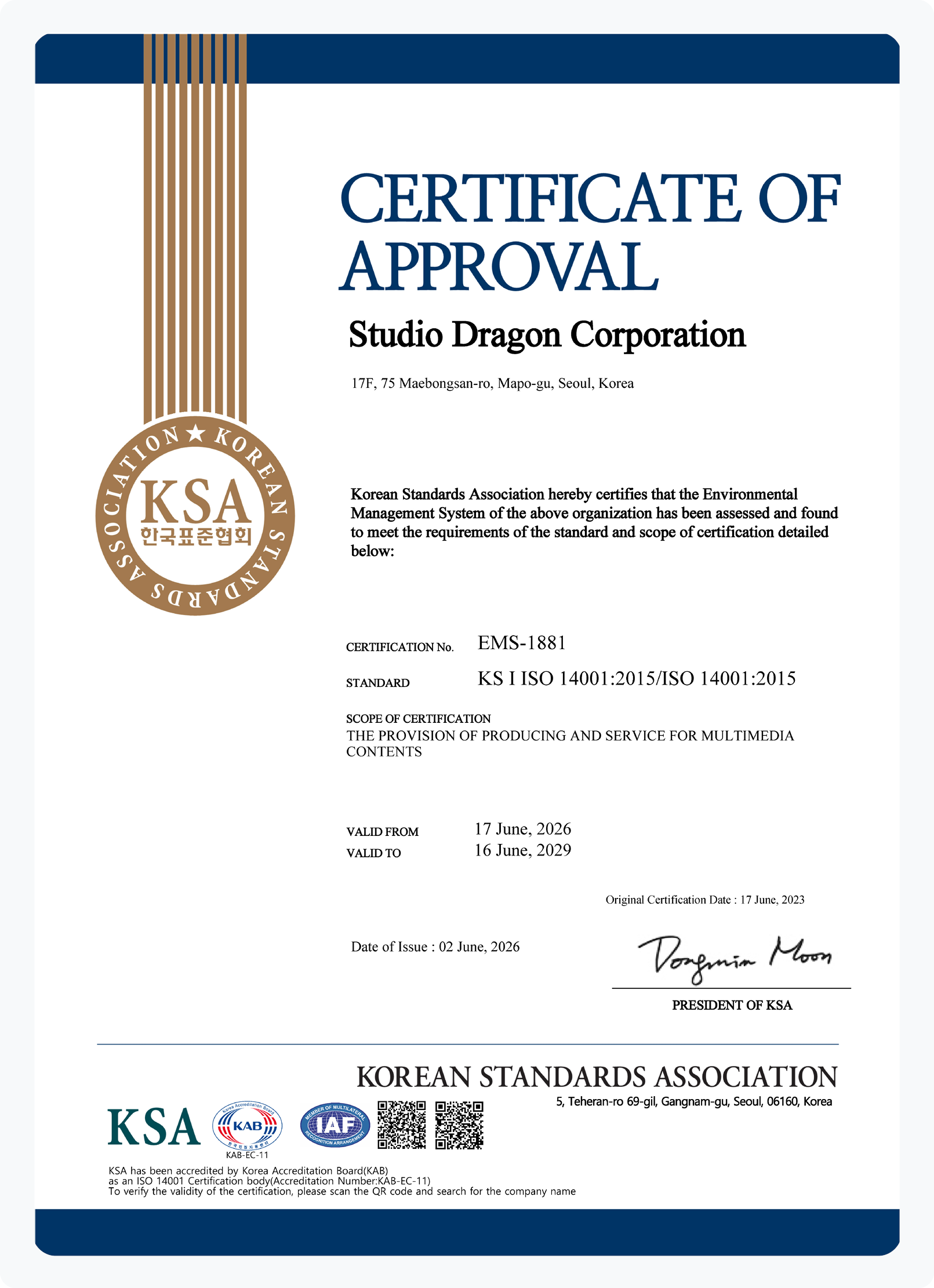
Scope: Studio Dragon (The Provision of producing and service for multimedia contents)
Validity Period: June 17, 2026 – June 16, 2029
Metrics
Studio Dragon tracks total waste generated and waste generation intensity at its headquarters office as key metrics for resource circulation and waste management. The company plans to expand its management scope to production sites for measuring and monitoring waste generation and recycling.
Category | Unit | 2023 | 2024 | 2025 |
|---|---|---|---|---|
Total Waste Generated1), 2) | Ton | 13.46 | 13.92 | 11.7 |
Waste Generation Intensity3) | Ton/KRW 100 million | 0.00189 | 0.00262 | 0.00223 |
Total Waste Recycled4), 5) | Ton | 13.46 | 13.92 | 11.7 |
1) Data covers headquarters only; production site data aggregation planned from 2027 report onward
2) General waste data calculated based on currently available waste synthetic resin treatment volume
3) Waste Generation Intensity = Total Waste Generated ÷ Annual Revenue (separate Basis)
4) Following the expansion of recycling volume calculation standards to include intermediate processed waste manufacturing, 2023 and 2024 data have been
restated (Previously, intermediate processed waste manufacturing was classified as other treatment volume)
5) Beyond officially aggregated recycling volumes, Studio Dragon is working to reduce waste through set material reuse and prop reuse (Environmental Management
& Resource Circulation)
Studio Dragon manages key environmental indicators, including environmental regulatory violations and sustainable procurement spending, while strengthening its environmental management framework. In 2026, the company will continue to advance this framework through sustained maintenance of ISO 14001 EMS certification, environmental management training for employees, and related initiatives.
Category | Unit | 2023 | 2024 | 2025 |
|---|---|---|---|---|
Green Procurement Spending | KRW million | 8.02 | 8.38 | 9.20 |
Environmental Regulatory Violations | Case | 0 | 0 | 0 |
Targets
Studio Dragon plans to continuously expand its prop reuse system to reduce waste generated during content production. In 2025, set materials (furniture, frames, and similar items) and specialty props (jewelry, prop weapons, and similar items) from two completed content productions were added to the prop warehouse. By 2030, the company plans to register props utilized in at least two productions a year into its in-house reuse database, establishing a systematic asset management foundation. In parallel, Studio Dragon will strengthen partnerships with prop recycling vendors through collaboration with its parent company CJ ENM. Over the long term, Studio Dragon will work toward raising the proportion of productions utilizing the prop and equipment warehouse to 100%, thereby contributing to the creation of a sustainable content production environment.
Category | Short-term (~2028) | Medium-term (~2035) | Long-term (~2050) |
|---|---|---|---|
Percentage of Scripted Titles Using Prop and Material Warehouse | 50% | 80% | 100% |