Climate Risk & GHG Emission
Governance
Strategy
Risk Management
Metrics and Targets
Decision-Making and Implementation Framework
Board Level
Studio Dragon's Sustainability Management Committee, which operates under the Board of Directors, reviews, deliberates, and approves major agenda items related to climate change. The committee convenes at least twice a year to discuss key matters including GHG management, environmental initiative implementation, sustainability report publication, and risk management. By doing so, the committee fulfills its responsibilities and role as the highest decision-making body for climate change response.
2025 Sustainability Committee Resolution: Climate Change-related Matters Resolved and Reported
1. | GHG Emissions Management |
| |
|---|---|---|---|
2. | Climate Change Strategy Implementation |
| |
3. | Sustainability Report Initiative |
| |
4. | Integrated Risk Management Framework Implementation |
|
Management Level
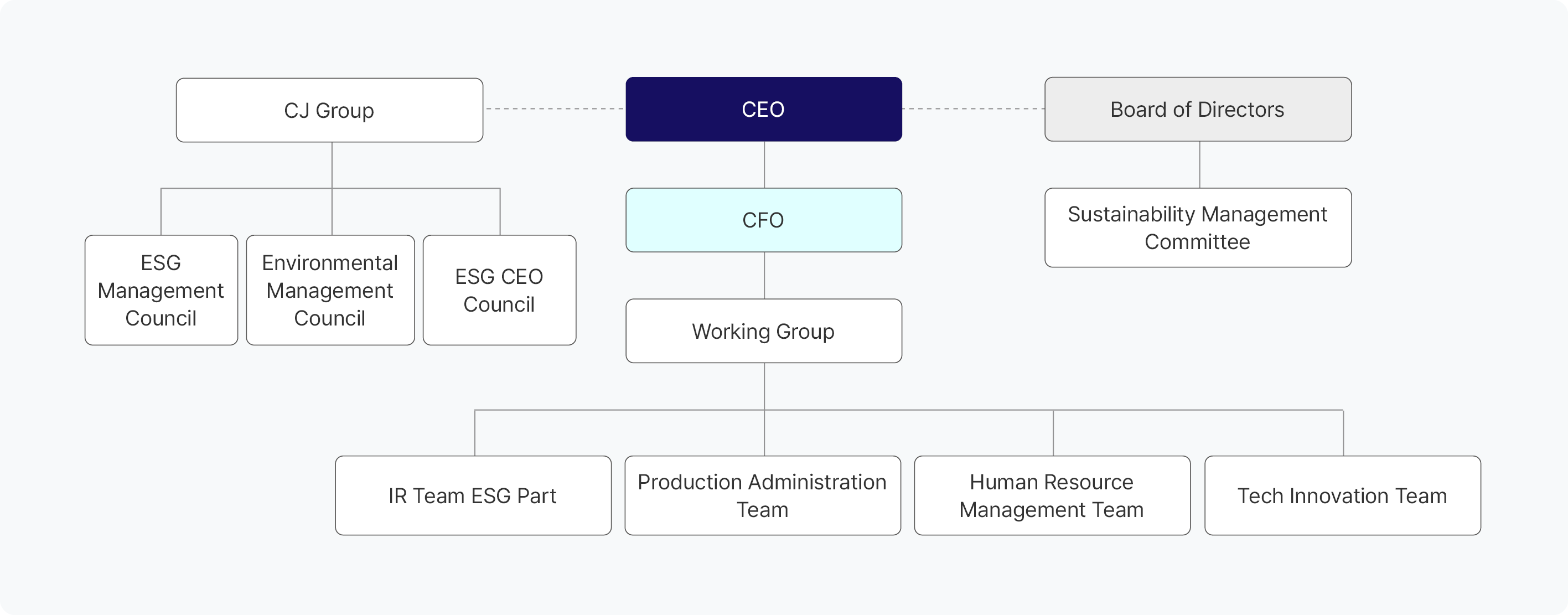
Studio Dragon has established a management-level framework for responding to climate change to systematically manage the impacts of climate change on its business operations and stakeholders.
The Chief Financial Officer (CFO), reporting to the CEO, oversees overall ESG management including climate change response. Through a Working Group chaired by the CFO, the company operates an execution framework based on cross-departmental collaboration. Led by the ESG Part of the IR Team, the Working Group comprises key departments—including the Production Administration Team, Human Resource Management Team, and the Tech Innovation Team—to identify climate-related risks and opportunities, establish response strategies, and manage GHG emissions. Through these efforts, Studio Dragon integrates management of environmental impacts that may arise during content production and business operations.
Studio Dragon Climate Change Response Organization Chart
Climate Risks and Opportunities
Identification of Climate Risks and Opportunities
Studio Dragon has identified a pool of climate-related risks and opportunities based on the IPCC (Intergovernmental Panel on Climate Change), TCFD (Task Force on Climate-related Financial Disclosures), and IFRS S2 (Climate-related Disclosures) standards, systematically analyzing the impact of climate change on its business. In identifying physical risks, transition risks, and opportunities, Studio Dragon comprehensively reflected internal and external environmental changes as well as industry characteristics, the operational characteristics of production sites, and policy and regulatory trends. To assess how these risks and opportunities affect the company, it has analyzed the entire value chain, spanning content IP sourcing (Upstream), in-house production processes (Operations), and content consumption (Downstream).
Climate-Related Risks and Opportunities
Risks and Opportunities | Business Model and Value Chain | |||||
|---|---|---|---|---|---|---|
Category | Impact Period1) | Value Chain | Business Impact | Timeframe | ||
Physical | P1 | Increased production costs due to intensifying heatwaves | All periods | Production | Restricted location filming schedules and shifts to night production increase labor and equipment costs, raising per-title production expenses | Current |
P2 | Production halts due to natural disasters such as typhoons and heavy rainfall | Short and medium term | Production | Production delays lead to programming disruptions and incur contractual penalties and re-production costs | Current | |
P3 | Deteriorating production environment due to rising average temperatures | Medium to long term | Production | Increased health risks for cast and crew, leading to higher safety management costs and reduced productivity | Current | |
Transition | T1 | Strengthened greenhouse gas and energy regulations | Medium to long term | Production | Restricted energy use at production sites and increased carbon costs; investment required for transition to low-carbon equipment | Anticipated |
T2 | Expanded ESG disclosure and investor requirements | Short and medium term | Distribution | Compliance costs arising from mandatory non-financial disclosure; failure to comply may reduce investment and partnership opportunities | Current | |
T3 | Strengthened resource circulation and waste regulations | Medium term | Production | Increased costs from stricter set and prop waste disposal standards; establishment of reuse and recycling systems required | Anticipated | |
Opportunity | O1 | Production efficiency improvement and energy cost reduction | Short and medium term | Production | Energy cost reduction and enhanced production competitiveness through the adoption of high-efficiency equipment and virtual production (VP) | Anticipated |
O2 | Sustainable production and strengthened content competitiveness | Medium to long term | Production | Enhanced negotiating power with global streaming services and investors and increased brand value through the acquisition of sustainable production certifications | Anticipated | |
1) Impact periods are categorized as short-term, medium-term, and long-term. Key analysis points are set at 2035 and 2050, taking into account the CJ Group
Net Zero Roadmap and the 2035 National Greenhouse Gas Reduction Targets (NDCs).
- Short-term: Within 3 years (~2028)
- Medium-term: 3 to 10 years (2028–2035)
- Long-term: Over 10 years (After 2035)
Identification of Material Climate Risks and Opportunities
Studio Dragon has conducted a climate-related materiality assessment to identify risks and opportunities that may have significant impacts on its business operations and the value chain. Aligned with the TCFD recommendations and IFRS S2 standards, the assessment applies quantitative and qualitative evaluation methodologies↗ based on likelihood and impact. Based on the results of the climate-related materiality assessment, Studio Dragon categorizes climate-related risks into four management levels: ‘Top-Priority Risks’, ‘Core Risks’, ‘Major Risks’, and ‘Management Risks’. In the 2025 assessment, Studio Dragon identified ‘increased production costs due to intensifying heatwaves’ as a Top-Priority Risk and conducted in-depth analysis to inform strategic management of this risk.
Climate Materiality Assessment Results
Category | Code | Risk/Opportunity | Materiality | Results |
Physical | P1 | Increased production costs due to more frequent heatwaves | Top-Priority Risk | 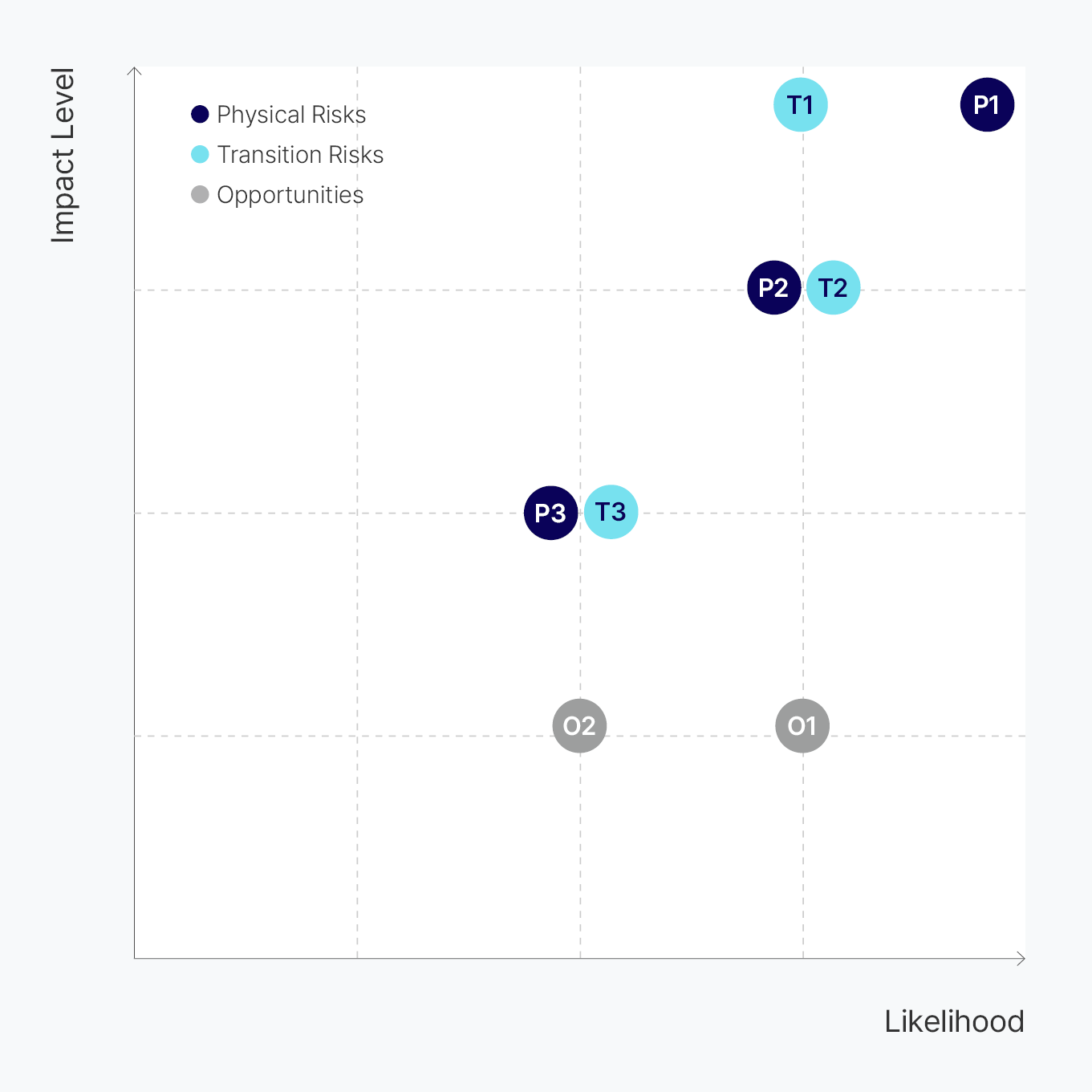 |
Transition | T1 | Strengthened greenhouse gas and energy regulations | Core Risk | |
Physical | P2 | Production halts due to natural disasters such as typhoons and heavy rainfall | Major Risk | |
Transition | T2 | Expanded ESG disclosure and investor requirements | Major Risk | |
Physical | P3 | Deteriorating production environment due to rising average temperatures | Management Risk | |
Transition | T3 | Strengthened resource circulation and waste regulations | Management Risk | |
Opportunity | O1 | Production efficiency improvement and energy cost reduction | Opportunity | |
Opportunity | O2 | Sustainable production and strengthened content competitiveness | Opportunity |
Strategy and Decision-Making
Detailed Response Strategies for Climate Risks and Climate Resilience
To proactively address climate change risks, Studio Dragon has established a company-wide climate risk response strategy across the organization, centered on three pillars: operations, technology, and management. Having identified increased production costs from intensifying heatwaves as its Top-Priority Risk, the company is developing action plans to minimize the negative impacts of material climate risks on its business and financial performance, and will systematically implement them across its overall production operations going forward. Additionally, by continuously strengthening its capacity for responding to climate risk and embedding climate resilience as a core management capability, Studio Dragon will build a stable, sustainable content production system capable of ensuring business continuity even amid a changing climate.
Detailed Climate Risk Response Strategy
Category | Key Initiatives | Implementation Details |
|---|---|---|
Operational Strategy | Adapting to Production Environment Changes and Enhancing Operational Efficiency |
|
Technology Strategy | Reducing Climate Dependency and Improving Production Efficiency |
|
Management Strategy | Strengthening Enterprise Risk Management and Disclosure Response Systems |
|
GHG Reduction Strategy and Energy Consumption Reduction Targets
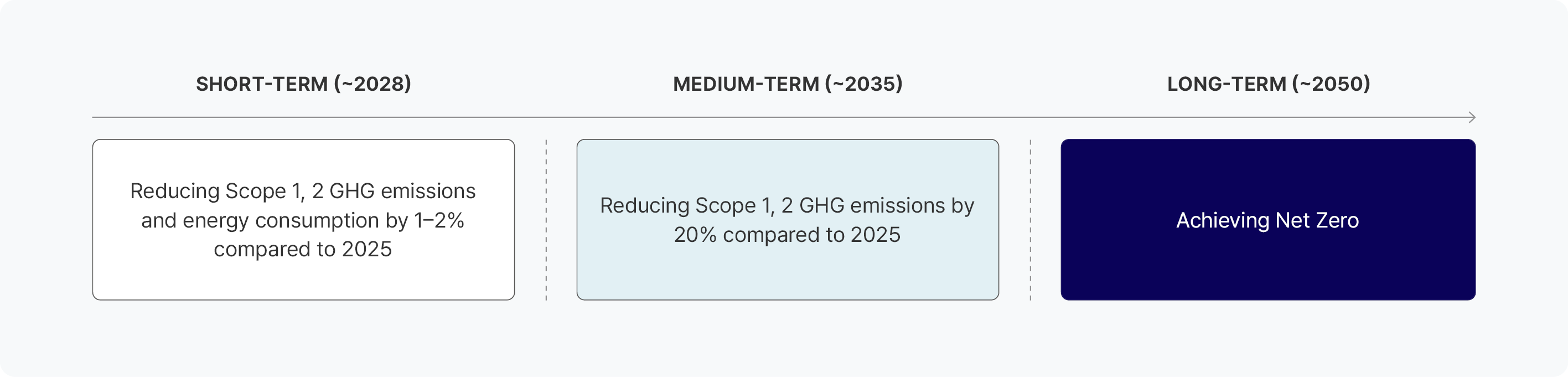
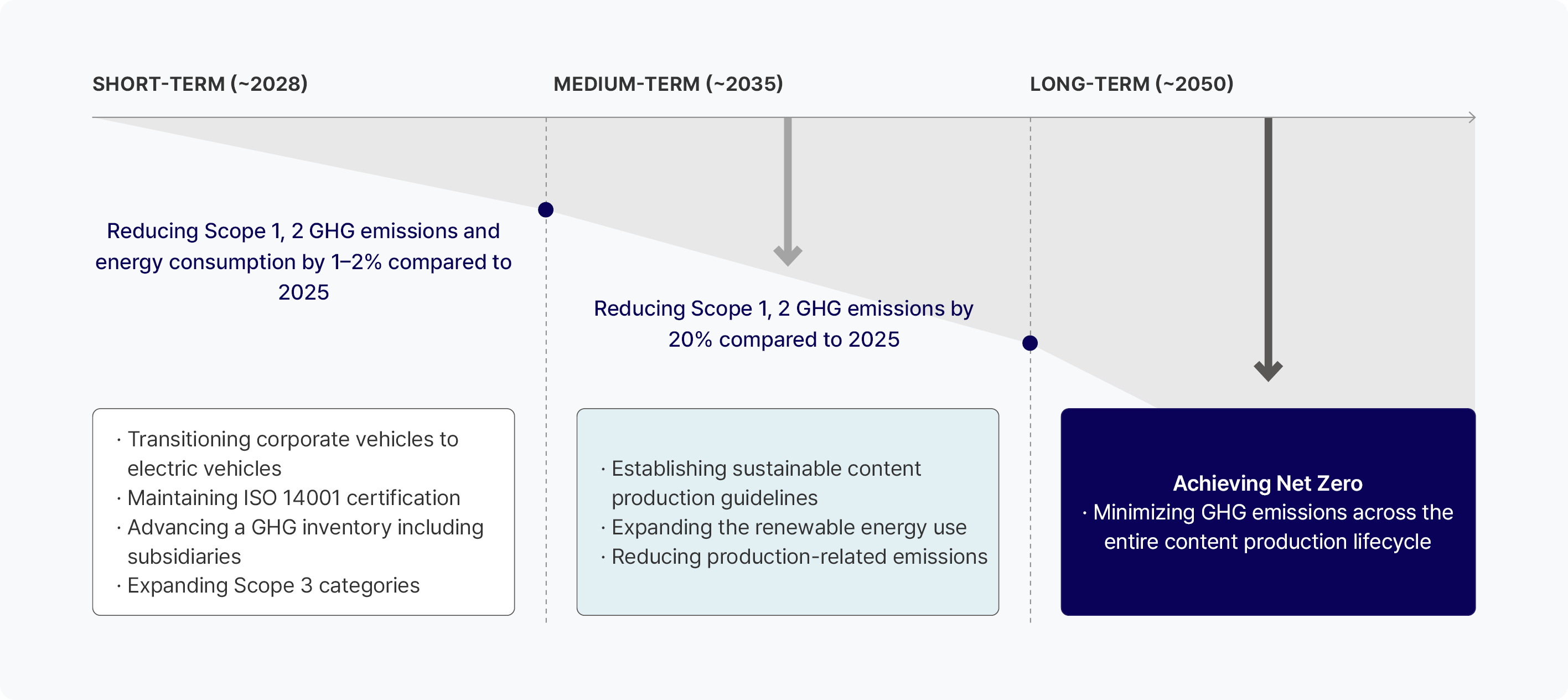
To proactively respond to climate change, Studio Dragon has established GHG emissions reduction strategies and targets across three time horizons: short-term (~2028), medium-term (~2035), and long-term (~2050). The company is implementing these strategies and targets in phases. Building on energy efficiency improvement activities and the development of its GHG inventory, the company is managing targets to reduce Scope 1 and Scope 2 GHG emissions and energy consumption by an average of 1–2% annually through 2028, using 2025 as the baseline year. Recognizing that its GHG emissions on a headquarters basis are relatively modest compared to other industries, the company is expanding its strategy beyond direct emission reduction to include indirect emission management across the supply chain and content production processes. The company plans to progressively expand its management scope to encompass Scope 3 emissions from upstream and downstream value chains as well as subsidiaries, thereby building a more systematic GHG management framework.
Additionally, despite the current institutional and market constraints, the company will continue to review direct renewable energy procurement options—such as Renewable Energy Power Purchase Agreements (PPAs) and Renewable Energy Certificates (RECs)—in line with evolving policies and market conditions, with plans for a phased introduction. Building on this phased approach, Studio Dragon will systematically implement its medium- and long-term GHG reduction targets and continuously advance its management framework, thereby accelerating its transition toward a low-carbon content production environment.
GHG Reduction Strategy and Targets
Climate Change Activities
Energy Reduction Initiatives
Studio Dragon contributes to reducing energy consumption by utilizing the ‘CJ ENM Studio Center’, a facility equipped with eco-friendly infrastructure. The studio features LED lighting, high-efficiency transformers, remote meter-reading systems, and automated lighting control systems—all of which provide an environment conducive to improving energy efficiency. As the exclusive user of the CJ ENM Studio Center, Studio Dragon plans to continue improving energy efficiency across its content production process as it expands its filming scale going forward.
GHG Inventory Enhancement
Studio Dragon has built and maintained a Scope 1 and 2 emissions inventory on a headquarters basis since 2020 to achieve its GHG reduction targets and has completed third-party verification of these emissions. As part of climate change initiatives, the company began calculating Scope 3 emissions in 2023 and has been progressively expanding its management scope. From 2025 onward, Studio Dragon has expanded its Scope 3 emissions calculation scope—previously focused on Business Travel (Category 6) —to include Employee Commuting (Category 7) and Waste Generated in Operations (Category 5). For business travel, the company has advanced its calculation methodology by applying granular standards that reflect the characteristics of each transportation mode. For commuting, it has enhanced data reliability based on employee surveys, establishing a system that enables more comprehensive identification and management of headquarters GHG emissions.
Going forward, in response to expanding disclosure requirements under international sustainability reporting standards such as IFRS S2, Studio Dragon plans to progressively broaden its Scope 3 management scope to include subsidiary operational emissions and Upstream Leased Assets (Category 8).
Climate Change Financial Impact
Financial Impact Assessment Based on Climate Change Scenarios
Studio Dragon has analyzed the financial impact of identified key climate risks and opportunities across three scenarios (Low, Mid, High). Each scenario reflects the intensity of climate change based on GHG emission pathways.
Category | Code | Risk/Opportunity | Scenario | Short-term | Medium-term | Long-term |
|---|---|---|---|---|---|---|
Physical | P1 | Increased Heatwaves | SSP1-2.6 | KRW 2.57 billion | SSP1: KRW 1.90 billion | Continuous increase in production costs |
P2 | Typhoons and Heavy Rainfall | Partial schedule delays | Filming schedule changes and additional costs | Filming halts and production disruptions | ||
P3 | Rising Average Temperature | Colling cost increase | Reduced production efficiency and schedule delays | Rising production costs and reduced productivity | ||
Transition | T1 | Strengthened Regulations | Carbon Pricing Increase Scenario | Energy cost increase | Increased investment in emissions reduction and equipment conversion | Shift in operational cost structure |
T2 | Investor Requirements | Expanded ESG Disclosure | Disclosure response required | Increased reputational impact and response costs | Potential constraints on investment attraction | |
T3 | Resource Circulation Regulation | Strengthened Waste Regulation | Increased waste disposal costs | Changes in operating processes | Expanded risk of regulatory non-compliance | |
Opportunities | O1 | Improvement Content Production Efficiency | Energy Savings Scenario | Cost reduction | Improved operating efficiency | Improved cost structure |
O2 | Sustainable Content | Market Expansion Scenario | Increased demand | Enhanced competitiveness | New market creation |
*This analysis constitutes estimates and projections derived from various climate scenarios and assumptions; therefore, actual financial impacts may differ materially
due to shifts in climate patterns, evolving policies and regulations, and changes in the production environment.
Going forward, Studio Dragon intends to continuously enhance the accuracy of its financial impact assessments related to climate change through ongoing data
accumulation and the refinement of analytical methodologies.

As of 2025, additional production costs attributable to more frequent heatwaves are estimated at approximately KRW 2.57 billion, representing approximately 0.7% of total production costs. Based on this figure, analysis of financial impact across future climate scenarios shows that the low-carbon scenario (SSP1-2.6) presents limited exposure, while the high-emission scenario (SSP5-8.5) demonstrates progressively increasing cost pressures. Under the SSP5-8.5 scenario specifically, additional production costs from heatwaves are projected to reach approximately KRW 6.9 billion by 2100—more than double current levels. These shifts create potential operational risks, including production schedule delays and reduced production efficiency.
To address these climate risks, Studio Dragon is actively pursuing operational efficiency measures, such as dispersing filming schedules across seasons and times of day, expanding the share of indoor and nighttime shoots, and improving working conditions at production sites. In parallel, Studio Dragon is reducing its exposure to climate risks by expanding VFX-based production and introducing AI-driven content creation methods, thereby enhancing production efficiency and strengthening its climate risk resilience.
Business Model and Value Chain Impact |
| ||||||||||||
|---|---|---|---|---|---|---|---|---|---|---|---|---|---|
Scope of Impact | Production (Upstream) | ||||||||||||
Timing of Occurrence | All timeframes (short, medium, long term) | ||||||||||||
Likelihood | Likely (High) | ||||||||||||
Financial Impact | Key Assumptions and Applied Scenarios
Financial Impact Level
Detailed Financial Impact Analysis
| ||||||||||||
Climate Risk and Opportunity Management Process
Risk and Opportunity Management Process
Studio Dragon operates a four-stage process—identification, assessment, materiality determination, and monitoring—to systematically manage climate risks and opportunities. During the identification phase, the company identifies physical risks, transition risks, and opportunity factors affecting the content production environment by incorporating global standards and recommendations such as IPCC and TCFD, policy and regulatory trends, and industry and production conditions. The subsequent quantitative and qualitative assessment phase applies a five-level evaluation for each identified factor based on likelihood and impact. For key risks, the company quantifies financial impact by incorporating the results of climate scenario analysis. In the materiality determination phase, the company derives a materiality matrix from the assessment results and establishes priorities by selecting key risk and opportunity factors with the highest potential impact. During the final monitoring phase, the company integrates selected key risks into its enterprise-wide risk management framework, continuously monitoring and refining the effectiveness of its climate response strategy. Studio Dragon manages climate risks and opportunities in conjunction with the company-wide risk management framework. The ESG organization oversees the climate risk management process and collaborates with major business units to regularly review the identification, assessment, and response status of climate risks and opportunities. Key climate risks are reviewed quarterly, and material matters are reported to management and the Sustainability Management Committee.
Climate-Related Risk and Opportunity Management Process
1. Risk and Opportunity Identification | 2. Quantitative and Qualitative Assessment | 3. Materiality Assessment | 4. Monitoring |
|---|---|---|---|
|
|
|
|
Materiality Assessment Criteriaㅣ Final materiality is derived by combining likelihood and impact, comprehensively reflecting the potential level of impact that each climate-related risk and opportunity factor may have on the business. Likelihood is assessed by considering climate scenarios, historical climate data, and changes in policy and market conditions. Impact is analyzed primarily through financial dimensions, including increased content production costs, reduced operational efficiency, and lost revenue opportunities. Studio Dragon comprehensively considers both likelihood and impact in establishing management priorities for climate risks. Risks assessed at Level 4 or above are designated as priority management targets and are subject to regular monitoring, while Level 5 risks are managed in connection with executive reporting and decision-making processes.
Likelihood and Impact Assessment Criteria
Level | Likelihood Definition | Impact Definition |
|---|---|---|
Level 1 | Very Low (Unlikely to occur) | Negligible Impact (Minor operational impact) |
Level 2 | Low (Limited likelihood of occurrence) | Limited Impact (Partial cost increase) |
Level 3 | Moderate (Possible in the medium term) | Moderate Impact (Production cost increase or schedule impact) |
Level 4 | High (Likely to occur in the near term) | High Impact (Business disruption and cost increase) |
Level 5 | Very High (Currently occurring or ongoing) | Very High Impact (Business suspension or significant loss) |
Climate Scenario Analysis Information
Scenario Overview
Studio Dragon conducts climate scenario analysis to quantitatively assess the financial impact of climate change on its business. This analysis is grounded in the Shared Socioeconomic Pathways (SSP) presented in the IPCC's Sixth Assessment Report (AR6) and applies the Republic of Korea's national standard climate change scenarios provided by the Korea Meteorological Administration (KMA) and the National Institute of Meteorological Sciences (NIMS). In particular, the analysis incorporated high-resolution climate projection data for the Korean Peninsula to reflect trends in the number of heatwave days. Studio Dragon also developed an impact model tailored to the characteristics of the content production sector, linking increases in filming days to rising production costs. The analysis spans three time horizons—short-term (within 3 years), medium-term (3–10 years), and long-term (10+ years)—with 2050 established as the primary analytical milestone, taking into account the CJ Group Net Zero Roadmap and the Republic of Korea's 2035 Nationally Determined Contribution (NDCs).
Metrics
As metrics for its climate change response, Studio Dragon has established and manages headquarters' Scope 1 and 2 emissions, Scope 3 emissions, GHG emissions intensity, energy consumption within the organization, energy intensity, and electricity usage. In 2025, the company expanded its Scope 3 GHG management scope by newly calculating emissions from Waste Generated in Operations (Category 5) and Employee Commuting (Category 7).
Category | Unit | 2023 | 2024 | 2025 | |
|---|---|---|---|---|---|
Total GHG Emissions (Scope 1 + Scope 2)1) | tCO₂eq | 422.988 | 391.528 | 427.415 | |
Scope 1 | tCO₂eq | 17.855 | 18.779 | 14.672 | |
Scope 2 (Location-based)2) | tCO₂eq | 405.133 | 372.749 | 412.743 | |
GHG Emissions Intensity (Scope 1 + Scope 2)3) | tCO₂eq/KRW 100 million | 0.06 | 0.07 | 0.08 | |
Scope 34) | tCO₂eq | 168.064 | 148.575 | 325.374 | |
Category 5. Waste Generated in Operation5) | tCO₂eq | - | - | 0.218 | |
Category 6. Business Travel | tCO₂eq | 168.064 | 148.575 | 218.252 | |
Category 7. Employee Commuting | tCO₂eq | - | - | 106.905 | |
Total Energy Consumption6) | TJ | 8.44 | 7.76 | 9.19 | |
Electricity Consumption | TJ | 6.94 | 6.25 | 7.56 | |
Energy Consumption Intensity7) | TJ/KRW 100 million | 0.00118 | 0.00146 | 0.00175 | |
1) GHG emissions data were calculated based on the headquarters business site for the reporting period.
2) 2024 data have been corrected due to a change in decimal place standards.
3) GHG Emissions Intensity (Scope 1 + Scope 2) = Total GHG Emissions (Scope 1 + Scope 2) ÷ Annual Revenue (separate Basis)
4) Each item is rounded to the third decimal place; consequently, the sum of individual figures may not exactly match the total due to rounding.
Scope 3 emissions for 2023 and 2024 were calculated for Category 6 (business travel) only.
From 2025 onward, the calculation scope has been expanded to include business travel, employee commuting, and waste.
5) Data calculation began in 2025.
6) Energy consumption data were calculated based on the headquarters business site for the reporting period.
7) Energy Consumption Intensity = Total Energy Consumption ÷ Annual Revenue (separate Basis)
Targets
Studio Dragon has established targets for managing and reducing GHG emissions and is pursuing them in phases. Building on its management of Scope 1 and Scope 2 emissions, Studio Dragon is managing toward a target of reducing emissions by an average of 1–2% annually through 2028, using 2025 as the baseline year. For 2025, the company set a Scope 1 and Scope 2 GHG emissions reduction target of 2% compared to the previous year, equivalent to 7.83 tCO₂eq. However, actual emissions increased to 427.41 tCO₂eq, and the target was not achieved. This increase was due to greater use of editing studios and changes in the calculation methodology for certain emission sources. Going forward, Studio Dragon plans to strengthen its management approaches to achieve future reduction targets.
Additionally, Studio Dragon plans to progressively expand its scope of Scope 3 GHG management scope to track emissions occurring across the value chain beyond its own operations. The company plans to further extend its management scope to include emissions generated during subsidiary operations and leased assets (Category 8: Upstream Leased Assets). Energy consumption will be managed with the same reduction target as GHG emissions—an average of 1–2% annually through 2028, using 2025 as the baseline year. Over the long term, Studio Dragon aims to systematically manage GHG emissions across content production and overall business operations to advance the achievement of 2050 Net Zero.
GHG Emissions Reduction Target